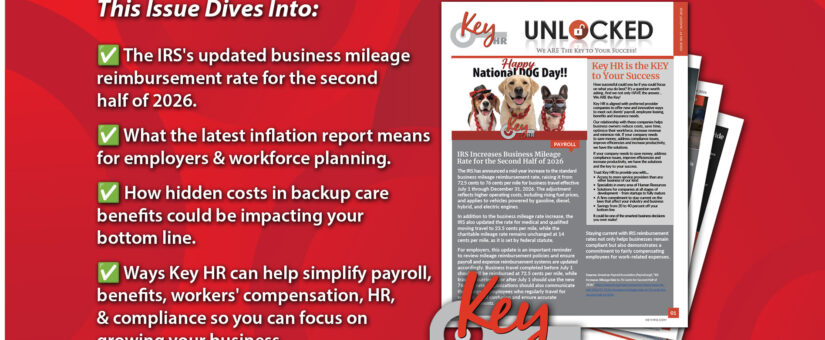
KEY HR UNLOCKED Newsletter – ISSUE NO. 97 | AUGUST . 2026
How successful could you be if you could focus on what you do best? It’s a question worth asking. And we not only HAVE the answer… We ARE the Key!
KeyHR is aligned with preferred provider companies to offer new and innovative ways to meet out clients’ payroll, employee leasing, benefits and insurance needs.
Our relationship with these companies helps business owners reduce costs, save time, optimize their workforce, increase revenue and minimize risk. If your company needs to save money, address compliance issues, improve efficiencies and increase productivity, we have the solutions.
If your company needs to save money, address compliance issues, improve efficiencies and increase productivity, we have the solutions and the key to your success.
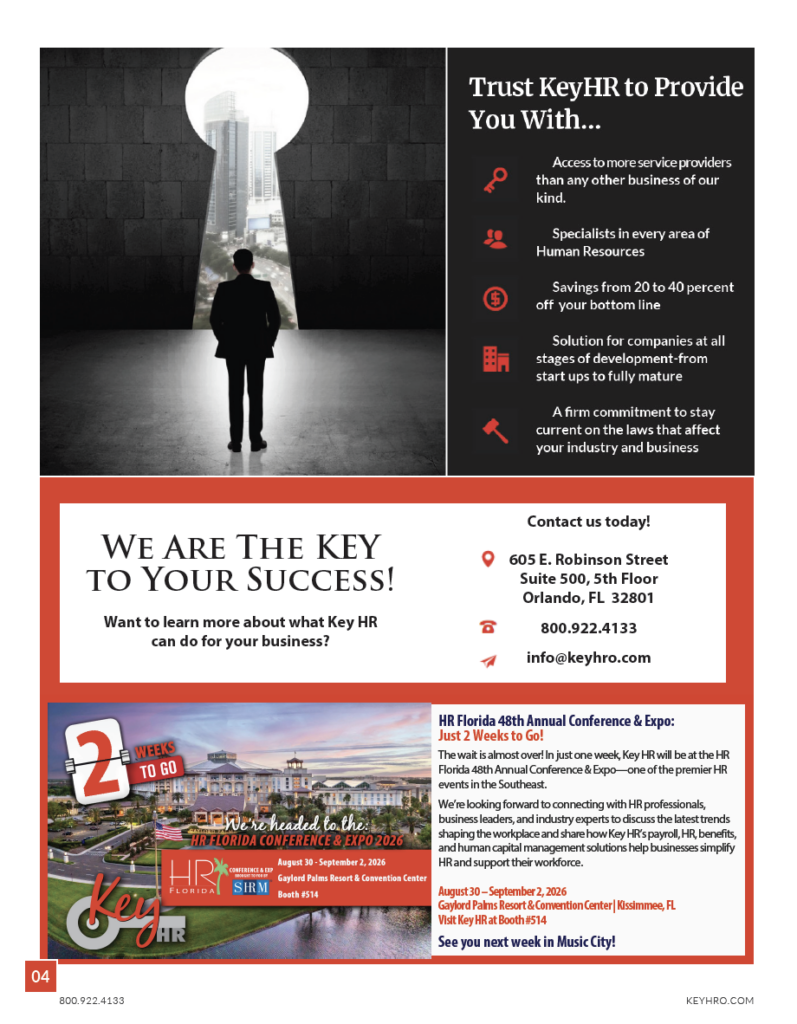
Trust Key HR to provide you with…
- Access to more service providers than any other business of our kind
- Specialists in every area of Human Resources
- Solutions for companies at all stages of development – from startups to fully mature
- A firm commitment to stay current on the laws that affect your industry and business
- Savings from 20 to 40 percent off your bottom line
- It could be one of the smartest business decisions you ever make!

IRS Increases Business Mileage Rate for the Second Half of 2026
The IRS has announced a mid-year increase to the standard business mileage reimbursement rate, raising it from 72.5 cents to 76 cents per mile for business travel effective July 1 through December 31, 2026. The adjustment reflects higher operating costs, including rising fuel prices, and applies to vehicles powered by gasoline, diesel, hybrid, and electric engines.
In addition to the business mileage rate increase, the IRS also updated the rate for medical and qualified moving travel to 23.5 cents per mile, while the charitable mileage rate remains unchanged at 14 cents per mile, as it is set by federal statute.
For employers, this update is an important reminder to review mileage reimbursement policies and ensure payroll and expense reimbursement systems are updated accordingly. Business travel completed before July 1 should still be reimbursed at 72.5 cents per mile, while travel occurring on or after July 1 should use the new 76-cent rate. Organizations should also communicate the change to employees who regularly travel for work to avoid confusion and ensure accurate reimbursements.
Staying current with IRS reimbursementrates not only helps businesses remain compliant but also demonstrates a commitment to fairl
y compensating employees for work-related expenses.
Source: American Payroll Association (Payroll.org0, “IRS Increases Mileage Rate to 76 Cents for Second Half of 2026.” https://payroll.org/news-resources/news/news-detail/2026/07/10/irs-increases-mileage-rate-to-76-cents-for-second-half-of-2026
The latest Consumer Price Index (CPI) report delivered encouraging news for employers, consumers, and financial markets. According to the U.S. Bureau of Labor Statistics, overall consumer prices declined 0.4% in June, marking the largest monthly decrease since 2020. On an annual basis, inflation slowed to 3.5%, down from 4.2% in May, largely driven by a sharp decline in energy prices. Meanwhile, core inflation, which excludes the more volatile food and energy categories, remained unchanged for the month and rose 2.6% over the past year, signaling that underlying inflationary pressures are continuing to ease.
While the report is a positive sign, SHRM notes that employers should avoid assuming inflation is no longer a concern. Costs for housing, healthcare, food, and other essential expenses remain elevated compared to previous years, and many employees continue to feel the financial strain. As a result, organizations may still face pressure to offer competitive wages, meaningful benefits, and financial wellness resources to attract and retain top talent.
For HR leaders and business owners, the latest inflation data reinforces the importance of thoughtful workforce planning. Compensation strategies, benefit offerings, and employee communication should continue to balance cost management with employee expectations. Businesses that regularly review salary structures, evaluate benefits packages, and invest in employee engagement will be better positioned to remain competitive, even as economic conditions continue to evolve.
Although June’s report suggests inflation is moving in the right direction, experts caution that economic conditions can change quickly. Monitoring future CPI reports and remaining flexible with workforce strategies will help organizations make informed decisions throughout the remainder of 2026.
Source: SHRM, “Inflation and CPI Update, June 2026; U.S. Bureau of Labor Statistics June 2026 Consumer Price Index Report”
https://www.shrm.org/topics-tools/news/benefits-compensation-inflation-cpi-june-2026
As employers continue looking for ways to attract and retain talent, backup care benefits have become an increasingly valuable resource for working parents and employees caring for aging family members. These programs provide temporary childcare or eldercare when regular care arrangements fall through, helping employees avoid missed workdays, reduce stress, and remain productive during unexpected situations.
However, a recent Benefit News article points out that many organizations may be paying more than they realize due to hidden out-of-network costs. While many backup care programs allow employees to use providers outside an approved network when in-network
options aren’t available, those out-of-network reimbursements often come with higher fees, lower reimbursement levels, and greater administrative complexity. Over time, these additional expenses can significantly reduce the overall value and effectiveness of the benefit, making it more costly for employers while creating inconsistent experiences for employees.
The article highlights one employer’s experience, where 91% of backup childcare claims were submitted through out-of-network providers. While employees appreciated the flexibility of being able to choose their own caregivers, the organization ultimately paid substantially more for the benefit than anticipated. This example demonstrates how limited provider networks, a lack of awareness about in-network options, and varying levels of provider availability can quietly drive up costs without improving employee outcomes.
Benefits experts recommend that employers take a closer look at how their backup care programs are being utilized. Reviewing utilization reports, evaluating provider network coverage, and educating employees about available in-network options can help organizations better manage expenses while still providing meaningful support. Employers should also work closely with their benefits partners to expand provider networks, simplify the reimbursement process, and ensure employees have easy access to reliable, high-quality care when they need it most.
As caregiving responsibilities continue to grow across today’s workforce, family- friendly benefits are becoming more than just a perk—they’re an important part of a company’s talent strategy. Employees who have dependable backup care are less likely to miss work unexpectedly, experience burnout, or leave the workforce altogether. In turn, employers benefit from improved attendance, higher productivity, stronger employee engagement, and increased retention.
For HR leaders, the takeaway is clear: offering backup care is only part of the solution. Regularly evaluating benefit utilization, identifying hidden costs, and ensuring employees understand how to maximize available resources can help organizations receive the greatest return on their investment while providing meaningful support to their workforce. A proactive approach to benefits management not only helps control expenses but also demonstrates a commitment to employee well-being—an important factor in building a resilient, engaged, and productive workforce.
Source: Benefit News, “How Out-of-Network Fees Erode Backup Care”
https://www.benefitnews.com/news/how-out-of-network-fees-erode-backup-care
Click To download the Key HR Newsletter UNCLOCKED

_________________________________
This communication is for informational purposes only; it is not legal, tax or
accounting advice; and is not an offer to sell, buy or procure insurance.
This post may contain hyperlinks to websites operated by parties other than KeyHR. Such hyperlinks
are provided for reference only. KeyHR does not control such websites and is not responsible for their content.
Inclusion of such hyperlinks on KeyHRO.com does not necessarily imply any endorsement of the material
on such websites or association with their operators
- Posted by admin
- On August 19, 2026
- 0 Comment

