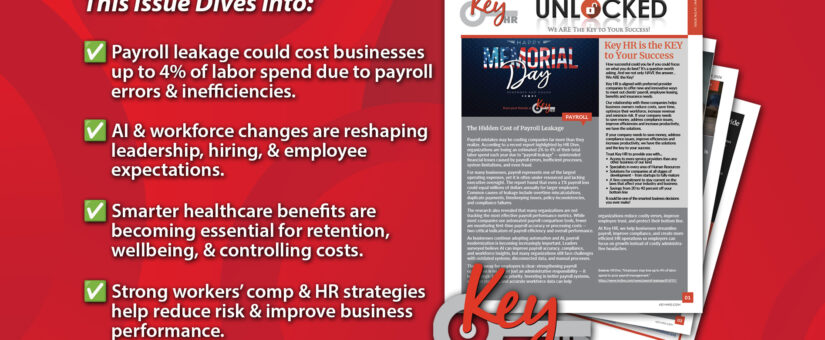
KEY HR UNLOCKED Newsletter – ISSUE NO. 95 | MAY . 2026
How successful could you be if you could focus on what you do best? It’s a question worth asking. And we not only HAVE the answer… We ARE the Key!
KeyHR is aligned with preferred provider companies to offer new and innovative ways to meet out clients’ payroll, employee leasing, benefits and insurance needs.
Our relationship with these companies helps business owners reduce costs, save time, optimize their workforce, increase revenue and minimize risk. If your company needs to save money, address compliance issues, improve efficiencies and increase productivity, we have the solutions.
If your company needs to save money, address compliance issues, improve efficiencies and increase productivity, we have the solutions and the key to your success.
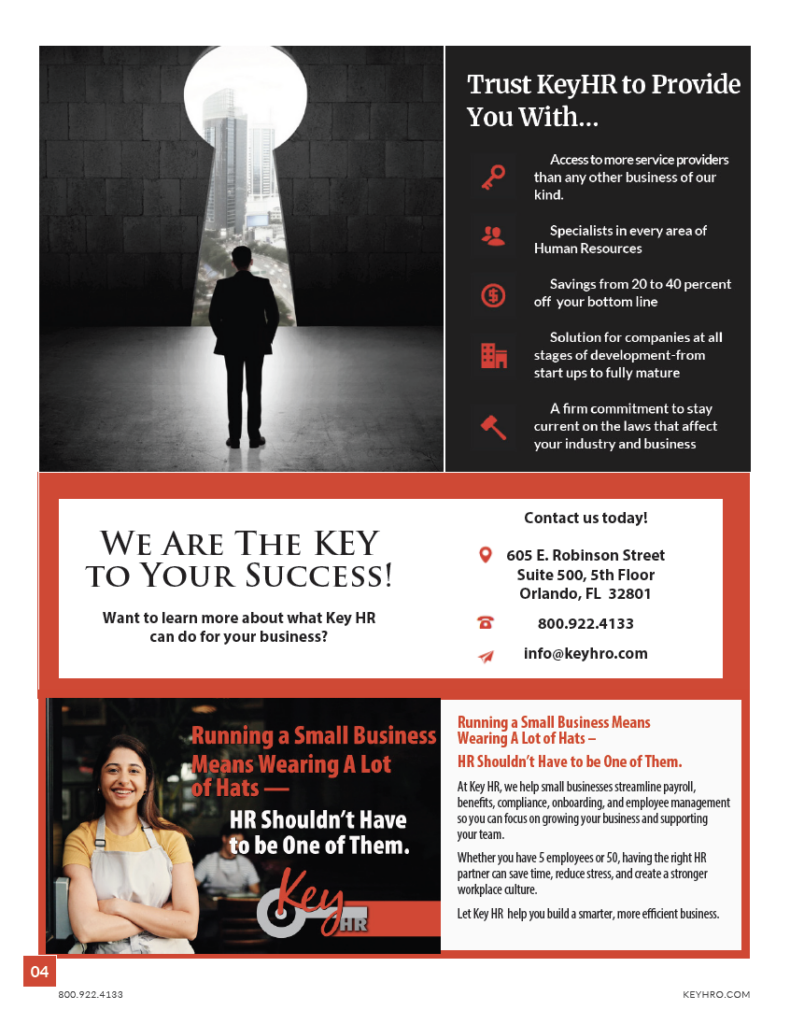
Trust Key HR to provide you with…
- Access to more service providers than any other business of our kind
- Specialists in every area of Human Resources
- Solutions for companies at all stages of development – from startups to fully mature
- A firm commitment to stay current on the laws that affect your industry and business
- Savings from 20 to 40 percent off your bottom line
- It could be one of the smartest business decisions you ever make!

The Hidden Cost of Payroll Leakage
Payroll mistakes may be costing companies far more than they realize. According to a recent report highlighted by HR Dive, organizations are losing an estimated 2% to 4% of their total labor spend each year due to “payroll leakage” — unintended financial losses caused by payroll errors, inefficient processes, system limitations, and even fraud.
For many businesses, payroll represents one of the largest operating expenses, yet it is often under-resourced and lacking executive oversight. The report found that even a 1% payroll loss could equal millions of dollars annually for larger employers. Common causes of leakage include overtime miscalculations, duplicate payments, timekeeping issues, policy inconsistencies, and compliance failures.
The research also revealed that many organizations are not tracking the most effective payroll performance metrics. While most companies use automated payroll comparison tools, fewer are monitoring first-time payroll accuracy or processing costs — two critical indicators of payroll efficiency and overall performance.
As businesses continue adopting automation and AI, payroll modernization is becoming increasingly important. Leaders surveyed believe AI can improve payroll accuracy, compliance, and workforce insights, but many organizations still face challenges with outdated systems, disconnected data, and manual processes.
The takeaway for employers is clear: strengthening payroll operations is no longer just an administrative responsibility — it is a strategic business priority. Investing in better payroll systems, stronger controls, and accurate workforce data can help organizations reduce costly errors, improve employee trust, and protect their bottom line.
At Key HR, we help businesses streamline payroll, improve compliance, and create more efficient HR operations so employers can focus on growth instead of costly administrative headaches.
Source: HR Dive, “Employers may lose up to 4% of labor spend to poor payroll management.” https://www.hrdive.com/news/payroll-leakage/816701/

Leadership in the Age of AI, Economic Uncertainty, & Workforce Transformation
Today’s business leaders are operating in one of the most rapidly changing workplace environments in decades. Artificial intelligence, shifting labor market trends, evolving employee expectations, and ongoing economic uncertainty are forcing organizations to rethink how they lead, hire, develop, and retain talent. A recent article from SHRM explores how employers must adapt to these changes in order to remain competitive and build resilient organizations for the future.
One of the most significant changes impacting the workforce is the rapid advancement of AI and workplace automation. While headlines often focus on fears of job replacement, many experts believe the larger shift is not about eliminating jobs entirely, but transforming how work gets done. AI tools are increasingly being integrated into everyday business operations, helping organizations automate repetitive tasks, improve efficiency, and analyze data faster than ever before. This means employers are now placing a greater emphasis on skills such as adaptability, critical thinking, creativity, and digital fluency.
Employees who can work alongside emerging technologies are becoming increasingly valuable. Businesses are now prioritizing workforce development and upskilling initiatives to ensure employees can adapt to changing roles and responsibilities. Organizations that invest in continuous learning opportunities are positioning themselves to stay ahead in a rapidly evolving marketplace.
At the same time, labor market pressures continue to create challenges for employers across nearly every industry. Recruiting qualified talent remains difficult in many sectors, while employee turnover and burnout continue to impact productivity and morale. Workers today are seeking more than just competitive pay — they want flexibility, meaningful work, strong leadership, career development opportunities, and healthier workplace cultures.
As a result, leadership itself is undergoing a major transformation. Traditional management styles focused solely on productivity and oversight are no longer enough. Employees increasingly expect leaders to communicate clearly, demonstrate empathy, support employee wellbeing, and create environments built on trust and transparency. Human-centered leadership is becoming one of the defining characteristics of successful organizations.
This shift is especially important as businesses continue navigating economic uncertainty and workplace disruption. Employees look to leadership teams for stability and direction during periods of change. Organizations that fail to communicate effectively or invest in their people often experience higher turnover, lower engagement, and increased operational challenges.
Another growing priority for employers is workforce planning. The modern workplace is changing too quickly for businesses to operate reactively. Companies are being forced to think strategically about future staffing needs, succession planning, compliance risks, technology adoption, and employee development. HR leaders are playing a larger role in long-term business strategy by helping organizations prepare for workforce disruptions before they occur.
The increasing complexity of HR compliance is also adding pressure to employers. Wage laws, employee classifications, workplace policies, leave requirements, and benefits administration continue to evolve, making it more important than ever for businesses to have strong HR systems and knowledgeable support in place. Small and mid-sized businesses, in particular, often struggle to balance growth with the administrative demands of managing employees effectively.
In addition, employee wellbeing has become a major business priority rather than simply a workplace perk. Burnout, stress, and mental health concerns continue to affect employee performance and retention. Companies are recognizing that supporting employee wellbeing through better communication, manageable workloads, flexible work arrangements, and stronger workplace cultures can directly impact business performance and long-term success.
The future of work will continue to evolve as technology advances and workforce expectations shift. Businesses that remain flexible, invest in their employees, and embrace strategic HR planning will be better positioned to attract top talent, improve retention, and maintain operational stability during periods of change.
At Key HR, we help businesses navigate today’s workforce challenges with customized HR solutions designed to support growth and long-term success. From payroll and compliance support to employee management, benefits administration, recruiting assistance, and strategic HR guidance, Key HR helps employers build stronger workplaces while staying focused on what matters most — their people.
Source: SHRM, “Future Focus: Leadership Shift, AI Chaos, and Labor Market Trends
https://www.shrm.org/topics-tools/news/future-focus-leadership-shift-ai-chaos-labor-market-trends
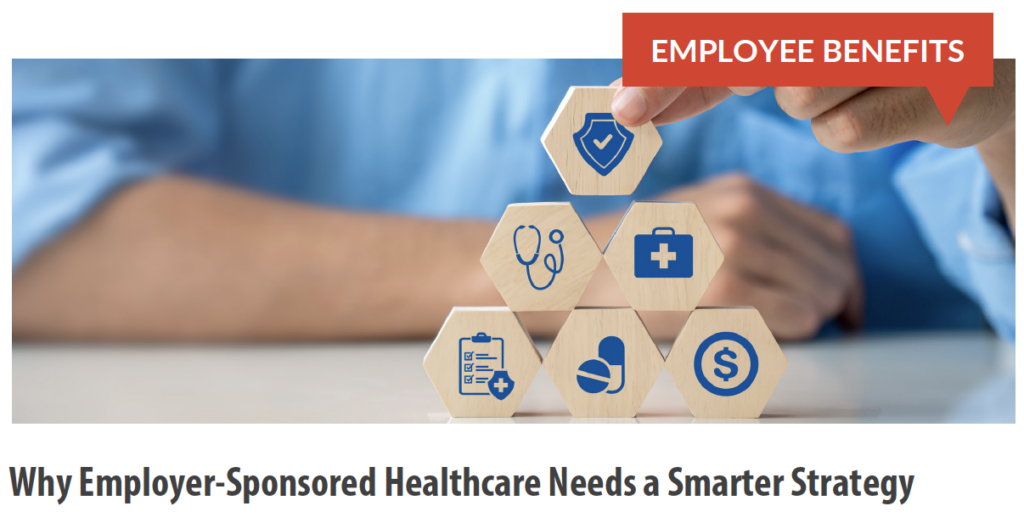
Employer-sponsored healthcare has become much more than a workplace benefit — it is now a major factor in employee retention, workforce productivity, and long-term business success. As healthcare costs continue to rise, employers are searching for better ways to balance affordability, employee satisfaction, and quality care. A recent article from Benefit News highlights how businesses are demanding more innovative and employee-focused healthcare solutions.
Today’s employers are taking a more strategic approach to healthcare benefits. Organizations are no longer focused solely on controlling costs; they are also evaluating how benefits impact recruitment, retention, employee wellbeing, and workplace culture. Employees increasingly expect accessible healthcare options, mental health support, virtual care services, and clear communication about their benefits. Companies that offer strong benefits packages are often better positioned to attract and retain top talent in a highly competitive labor market.
At the same time, rising healthcare expenses continue to pressure businesses of all sizes. Many employers are struggling to maintain competitive benefits while managing increasing insurance costs, expensive specialty medications, and growing healthcare utilization. As a result, companies are looking for healthcare partners that provide more transparency, technology, and support tools to help employees better navigate their healthcare options while also improving cost efficiency.
Digital healthcare solutions are becoming more important than ever. Tools such as telehealth services, online scheduling, price transparency platforms, and personalized healthcare resources are helping employees access care more efficiently while improving the overall benefits experience. Businesses are also recognizing that proactive healthcare strategies can help reduce burnout, improve employee satisfaction, and strengthen workforce retention.
The article also emphasizes the importance of stronger collaboration between employers, healthcare providers, and insurance payers. Organizations want integrated solutions that simplify benefits administration, improve communication, and deliver measurable value for both employers and employees. Businesses that take a proactive approach to healthcare planning are more likely to build healthier, more engaged, and more productive workforces.
As workforce expectations continue to evolve, companies that invest in smarter healthcare strategies will be better positioned to attract top talent, improve employee engagement, and control long-term costs.
At Key HR, we help businesses navigate the growing complexities of employee benefits, payroll, compliance, and workforce management. Our team works with employers to create competitive HR and benefits strategies that support both business growth and employee wellbeing in today’s changing workplace environment.
Source: Benefit News, “Benefits Think Why payers must lead the charge for better employer-sponsored healthcare”
https://www.benefitnews.com/opinion/why-payers-must-lead-the-charge-for-better-employer-sponsored-healthcare
Click To download the Key HR Newsletter UNCLOCKED

_________________________________
This communication is for informational purposes only; it is not legal, tax or
accounting advice; and is not an offer to sell, buy or procure insurance.
This post may contain hyperlinks to websites operated by parties other than KeyHR. Such hyperlinks
are provided for reference only. KeyHR does not control such websites and is not responsible for their content.
Inclusion of such hyperlinks on KeyHRO.com does not necessarily imply any endorsement of the material
on such websites or association with their operators
- Posted by admin
- On May 14, 2026
- 0 Comment

