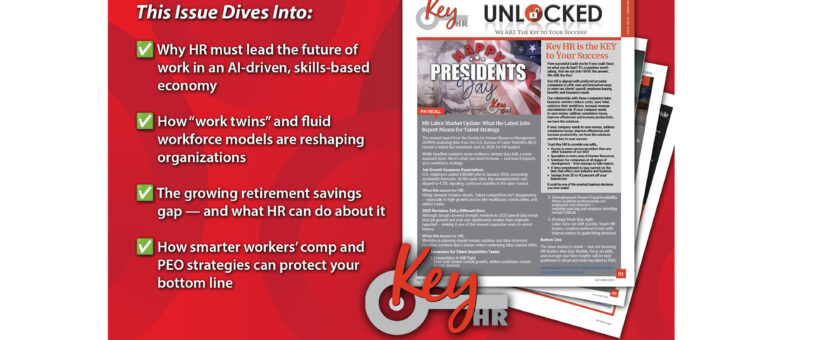
KEY HR UNLOCKED Newsletter – ISSUE NO. 92 | February . 2026
How successful could you be if you could focus on what you do best? It’s a question worth asking. And we not only HAVE the answer… We ARE the Key!
KeyHR is aligned with preferred provider companies to offer new and innovative ways to meet out clients’ payroll, employee leasing, benefits and insurance needs.
Our relationship with these companies helps business owners reduce costs, save time, optimize their workforce, increase revenue and minimize risk. If your company needs to save money, address compliance issues, improve efficiencies and increase productivity, we have the solutions.
If your company needs to save money, address compliance issues, improve efficiencies and increase productivity, we have the solutions and the key to your success.
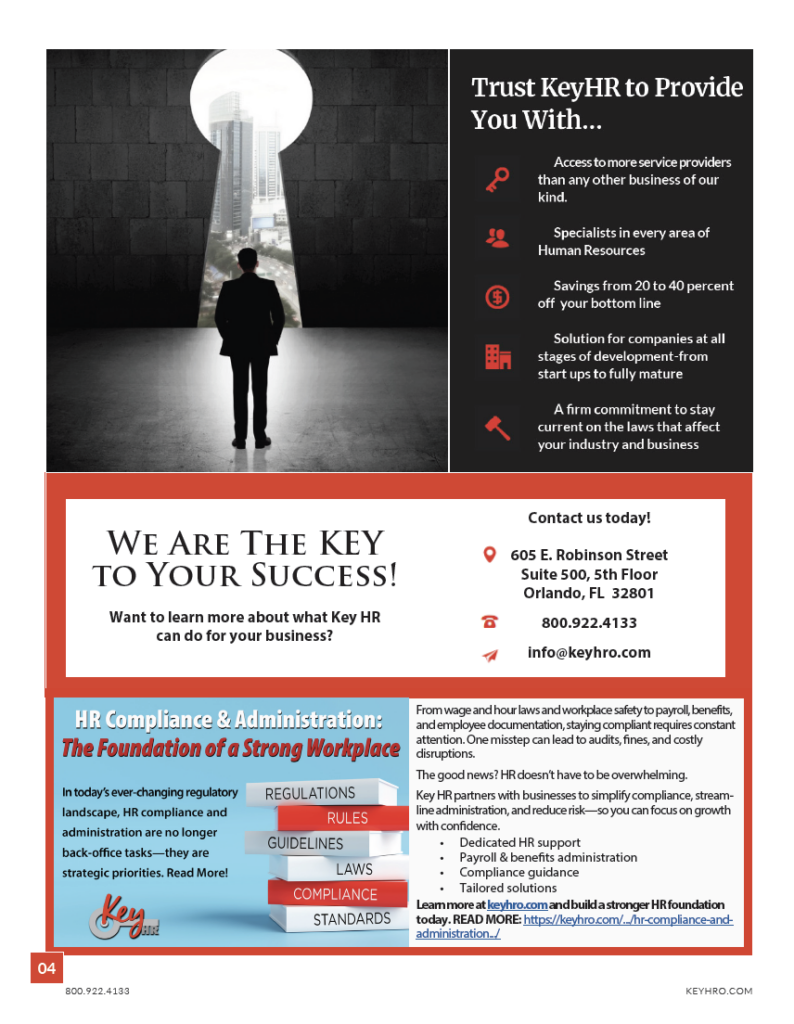
Trust Key HR to provide you with…
- Access to more service providers than any other business of our kind
- Specialists in every area of Human Resources
- Solutions for companies at all stages of development – from startups to fully mature
- A firm commitment to stay current on the laws that affect your industry and business
- Savings from 20 to 40 percent off your bottom line
- It could be one of the smartest business decisions you ever make!

HR Labor Market Update: What the Latest Jobs Report Means for Talent Strategy
The newest report from the Society for Human Resource Management (SHRM) analyzing data from the U.S. Bureau of Labor Statistics (BLS) reveals a mixed but important start to 2026 for HR leaders.
While headline numbers show resilience, deeper data tells a more nuanced story. Here’s what you need to know — and how it impacts your workforce strategy.
Job Growth Surpasses Expectations
U.S. employers added 130,000 jobs in January 2026, exceeding economist forecasts. At the same time, the unemployment rate dipped to 4.3%, signaling continued stability in the labor market.
What this means for HR:
Hiring demand remains steady. Talent competition isn’t disappearing — especially in high-growth sectors like healthcare, construction, and skilled trades.
2025 Revisions Tell a Different Story
Although January showed strength, revisions to 2025 payroll data reveal that job growth last year was significantly weaker than originally reported — making it one of the slowest expansion years in recent history.
What this means for HR:
Workforce planning should remain cautious and data-informed. Headline numbers don’t always reflect underlying labor market shifts.
Key Takeaways for Talent Acquisition Teams
1️. Competition Is Still Tight
Even with slower overall growth, skilled candidates remain in high demand.
2. Unemployment Doesn’t Equal Availability
Many qualified professionals are employed and selective — meaning sourcing and employer branding remain critical.
3️. Strategy Must Stay Agile
Labor data can shift quickly. Smart HR leaders combine national trends with internal metrics to guide hiring decisions.
Bottom Line
The labor market is stable — but not booming. HR leaders who stay flexible, focus on skills, and leverage real-time insights will be best positioned to attract and retain top talent in 2026.
shrm.org/topics-tools/news/talent-acquisition/bls-hr-jobs-unemployment-feb-2026
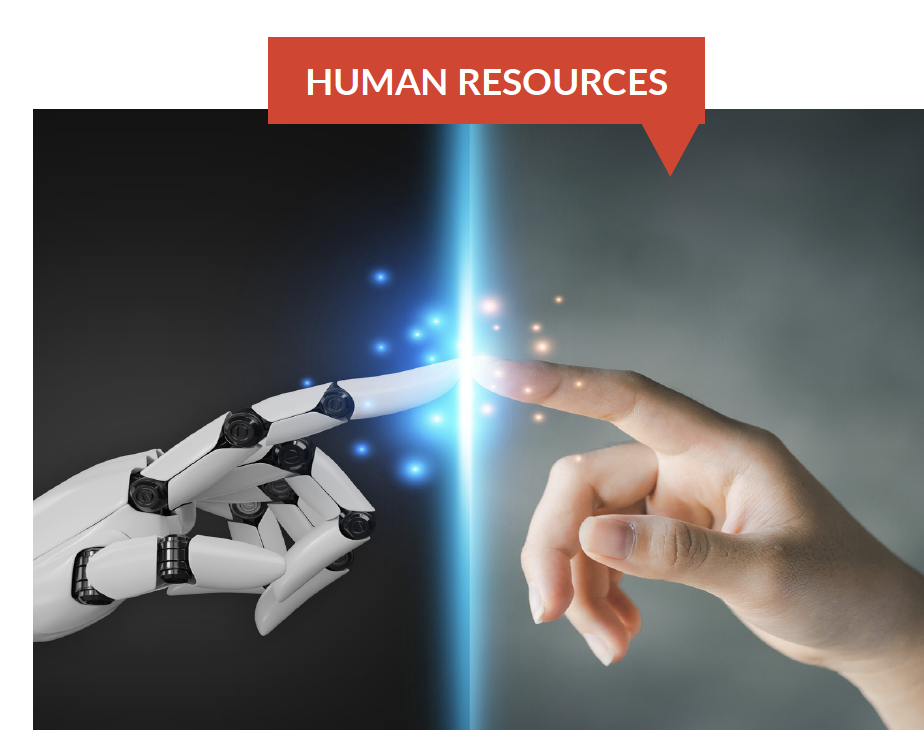
The Future of Work Is Being Built — and HR Must Lead the Design
If 2025 felt like shaking ground for your organization, get ready — 2026 is the year everything starts to settle into a new normal. Not a return to the old way of doing things, but the beginning of a redesigned future of work.
As AI, talent scarcity, economic uncertainty, and shifting skills demands reshape business faster than ever, one thing is clear: work itself is being rebuilt from the ground up. And HR is uniquely positioned to lead that redesign — if it steps up to own the blueprint.
Work Is No Longer About Tasks — It’s About Systems
Not long ago, AI was considered just another tool in the HR toolbox. Now it’s evolving into the infrastructure that underpins how work gets done. AI isn’t an assistant — it’s becoming the foundation of how teams operate, how decisions are made, and how talent is deployed.
But integrating AI isn’t about flipping a switch. Early internet adoption looked promising but only delivered widespread value after experimentation, refinement, and disciplined implementation. AI is following the same path — fast-moving, but not instantly transformative on its own.
The organizations that win will combine bold ambition with governance, people strategy, and cultural readiness — not just the latest tech trends.
Skills, Not Jobs, Are the New Currency
For decades, businesses were organized around static job titles, levels, and hierarchies. Today, those frameworks are breaking down. Instead of thinking in terms of “jobs,” organizations need to think in terms of skills, capabilities, and dynamic roles.
Only about 12 % of companies have fully operational skills strategies today. But those that do are far outperforming their peers in growth, profitability, market share, and customer satisfaction.
This shift isn’t just philosophical — it’s practical. AI doesn’t care about job titles; it cares about skills. Workforce planning in 2026 moves away from annual headcounts and toward continuous capability mapping, keeping organizations responsive and competitive.
Meet Your Work Twin: The AI Colleague of the Future
One of the most intriguing developments on the horizon? AI “work twins.” These are digital assistants trained not just to respond to prompts, but to mirror a worker’s expertise, judgment, and patterns — taking on ongoing tasks like scheduling, drafting content, analyzing data, and more.
This raises new questions for leaders:
- Who owns the output of a human–AI partnership?
- How should performance be measured when part of the team never sleeps?
- What happens to an AI work twin if the human leaves?
Organizations that embrace AI as a collaborator — not a replacement — and build governance and transparency into how it’s used will get the biggest value.
The Old Org Chart Is Dead — Long Live the Fluid Workforce
The classic hierarchical org chart was designed in the 1800s — and it’s showing its age. The future of work is modular, fluid, and project- based, blending:
- Full-time employees
- Contingent and gig workers
- AI agents
- Internal talent marketplaces that match people to work based on skills and demand
In this world, managers aren’t “owners” of people. They’re orchestrators of capability, aligning talent to where it creates the most value.
Boards Are Watching — And HR Must Speak a New Language
CEOs and boards are no longer satisfied with anecdotal HR reporting. They want evidence-based workforce strategies, real assessments of AI impact, talent risk data, and cultural health metrics.
Workforce readiness is now business readiness. HR leaders who can talk strategy, scenario planning, and capability forecasting won’t just survive — they’ll become essential to organizational success.
Agility Is the Competitive Advantage
What ties all these shifts together? Agility. The organizations that thrive won’t be the biggest or richest — they’ll be the ones that treat work as a living, adaptable system. They’ll use skills as the language of operation and AI as a structural force, and they’ll build cultures where adaptation is expected — not feared.
And at the heart of this transformation? HR — if it chooses to fully own the blueprint for the future of work.
hrexecutive.com/the-architecture-of-work-is-changing-hr-must-own-the-blueprint/
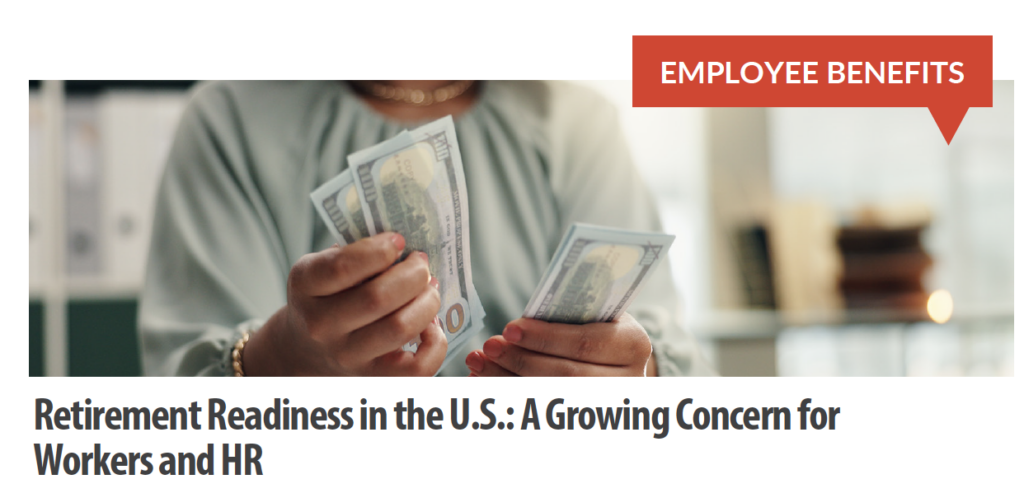
A recent analysis shows a troubling trend in retirement preparedness: many American workers still lack access to employer-provided retirement plans — a key vehicle for long-term financial security.
Retirement Plan Access Is Uneven
According to data from the National Institute on Retirement Security and the U.S. Census Bureau’s Survey of Income and Program Participation, only about half of U.S. workers have access to a defined contribution retirement plan, like a 401(k), through their employer.
Meanwhile, Bureau of Labor Statistics estimates show that roughly 70–72% of private-industry workers had access to retirement benefits in 2025, but access falls sharply in small firms.
These gaps mean millions of workers lack the opportunity to save via payroll deductions, a method strongly linked to higher participation and savings rates.
What This Means for Retirement Savings
The difference in retirement outcomes between workers with and without access is stark:
- Among those with a defined contribution plan, median retirement savings was roughly $40,000.
- When including all workers — even those without any savings — the median drops dramatically to around $955.
In other words: if workers can’t save through their employer, many likely aren’t saving at all.
Without easier plan access and stronger participation, long-term financial insecurity will likely grow as Social Security benefits face pressure from demographic and fiscal challenges.
Why Access Gaps Persist
Several factors contribute to uneven retirement plan access:
- Size of Employer — Workers in smaller firms are much less likely to have access than those at larger organizations.
- Wage Levels and Worker Demographics — Low- and moderate-income workers, as well as Black and Hispanic employees, are disproportionately cut off from employer plans.
- Nontraditional Work Arrangements — Gig, contract, and part-time workers often lack access to any employer-facilitated retirement savings options.
What HR Can Do
As retirement planning becomes a more urgent employee need, HR teams can play a pivotal role by:
- Educating employees about retirement benefits options and the impact of long-term saving.
- Evaluating new benefits solutions, such as payroll deduction savings programs or auto-enrollment features.
- Working with leadership to explore cost-effective retirement offerings that boost access and engagement.
Key Takeaways
- Retirement plan access remains uneven, especially in small firms and among lower-wage workers.
- Median savings for all workers is critically low, underscoring the importance of employer plans.
- HR is uniquely positioned to close gaps and help employees build secure financial futures.
hrdive.com /news/many-workers-lack-access-to-employer-provided-retirement-plans/812010/
Click To download the Key HR Newsletter UNCLOCKED

_________________________________
This communication is for informational purposes only; it is not legal, tax or
accounting advice; and is not an offer to sell, buy or procure insurance.
This post may contain hyperlinks to websites operated by parties other than KeyHR. Such hyperlinks
are provided for reference only. KeyHR does not control such websites and is not responsible for their content.
Inclusion of such hyperlinks on KeyHRO.com does not necessarily imply any endorsement of the material
on such websites or association with their operators
- Posted by admin
- On February 19, 2026
- 0 Comment

