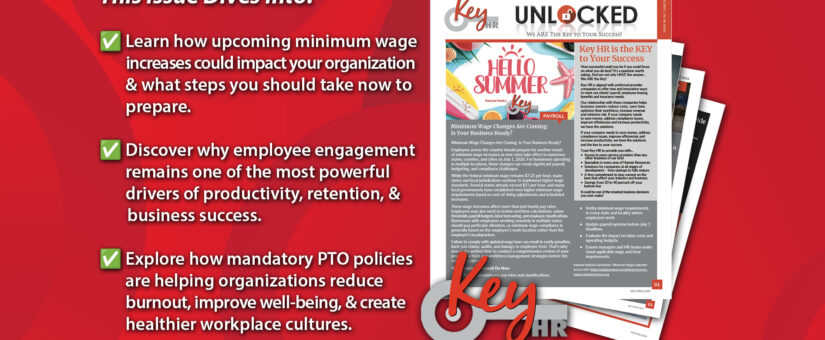
KEY HR UNLOCKED Newsletter – ISSUE NO. 96 | JUNE . 2026

How successful could you be if you could focus on what you do best? It’s a question worth asking. And we not only HAVE the answer… We ARE the Key!
KeyHR is aligned with preferred provider companies to offer new and innovative ways to meet out clients’ payroll, employee leasing, benefits and insurance needs.
Our relationship with these companies helps business owners reduce costs, save time, optimize their workforce, increase revenue and minimize risk. If your company needs to save money, address compliance issues, improve efficiencies and increase productivity, we have the solutions.
If your company needs to save money, address compliance issues, improve efficiencies and increase productivity, we have the solutions and the key to your success.
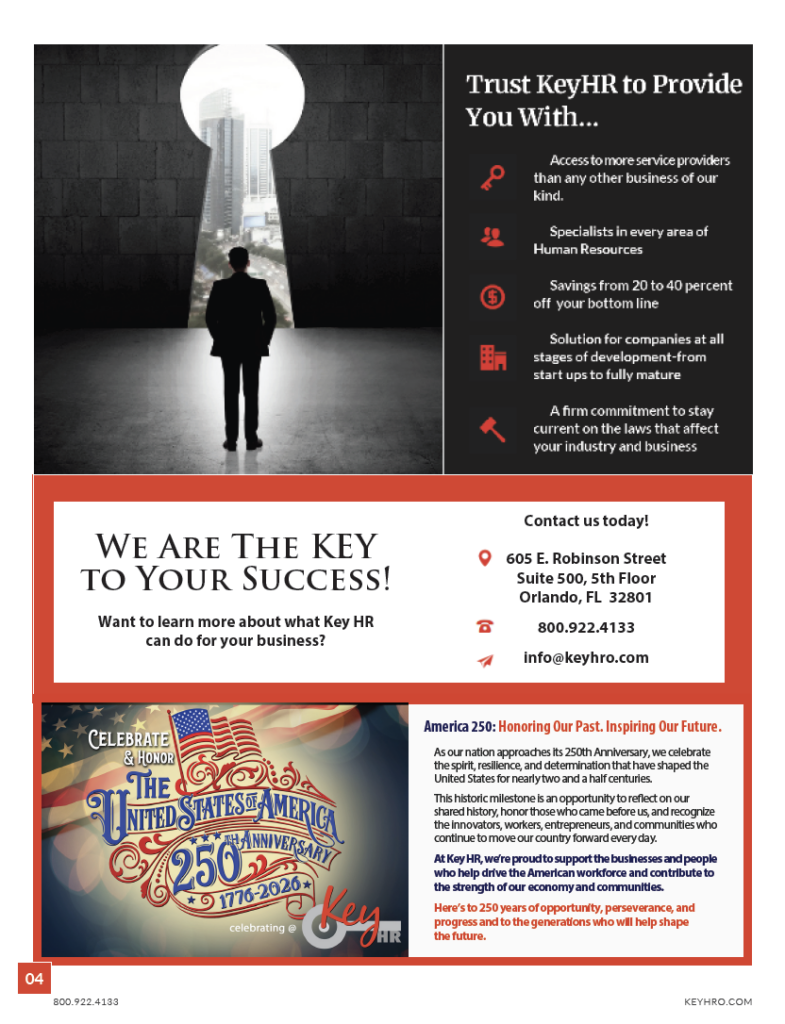
Trust Key HR to provide you with…
- Access to more service providers than any other business of our kind
- Specialists in every area of Human Resources
- Solutions for companies at all stages of development – from startups to fully mature
- A firm commitment to stay current on the laws that affect your industry and business
- Savings from 20 to 40 percent off your bottom line
- It could be one of the smartest business decisions you ever make!

Minimum Wage Changes Are Coming: Is Your Business Ready?
Minimum Wage Changes Are Coming: Is Your Business Ready?
Employers across the country should prepare for another round of minimum wage increases as new rates take effect in numerous states, counties, and cities on July 1, 2026. For businesses operating in multiple locations, these changes can create significant payroll, budgeting, and compliance challenges.
While the federal minimum wage remains $7.25 per hour, many states and local jurisdictions continue to implement higher wage standards. Several states already exceed $15 per hour, and many local governments have established even higher minimum wage requirements based on cost-of-living adjustments and scheduled increases.
These wage increases affect more than just hourly pay rates. Employers may also need to review overtime calculations, salary thresholds, payroll budgets, labor forecasting, and employee classifications. Businesses with employees working remotely in multiple states should pay particular attention, as minimum wage compliance is generally based on the employee’s work location rather than the employer’s headquarters.
Failure to comply with updated wage laws can result in costly penalties, back-pay claims, audits, and damage to employee trust. That’s why now is the perfect time to conduct a comprehensive review of your payroll practices and workforce management strategies before the new rates take effect.
What Employers Should Do Now
- Review all employee pay rates and classifications.
- Verify minimum wage requirements in every state and locality where employees work.
- Update payroll systems before July 1 deadlines.
- Evaluate the impact on labor costs and operating budgets.
- Ensure managers and HR teams under stand applicable wage and hour requirements.
Source: National Law Review, “Minimum Wages Adjusted Across USA.”, https://natlawreview.com/article/minmum-wages-adjusted-across-usa
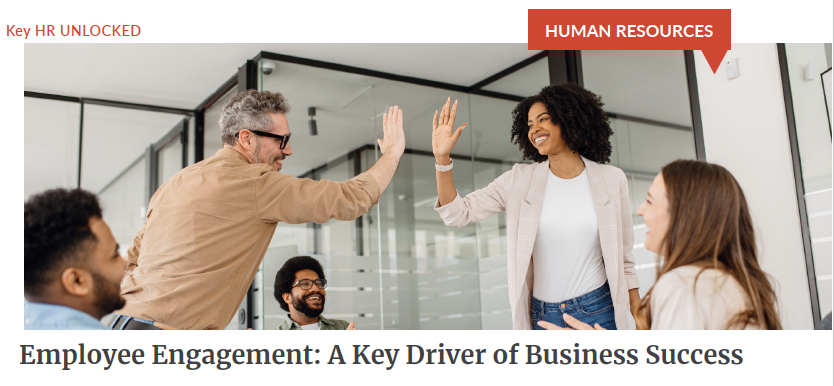
Employee engagement has become one of the most important factors in building a productive, resilient, and successful workforce. In today’s competitive labor market, organizations that prioritize engagement are better positioned to attract top talent, improve retention, and drive long-term growth.
Employee engagement goes beyond job satisfaction. Engaged employees are emotionally invested in their work, committed to organizational goals, and motivated to contribute to the company’s success. When employees feel valued and connected to their workplace, they are more likely to perform at a higher level, collaborate effectively, and provide exceptional service to customers.
The benefits of a highly engaged workforce are significant. Organizations often experience increased productivity, lower turnover, reduced absenteeism, stronger workplace cultures, and improved overall performance. On the other hand, disengaged employees can contribute to lower morale, decreased productivity, and higher recruitment and training costs.
How Employers Can Improve Engagement
Encourage Open Communication
Employees want to feel heard. Regular feedback, transparent communication, and opportunities for employees to share their ideas help build trust and strengthen workplace relationships.
Recognize Employee Contributions
A simple thank you can go a long way. Recognizing employees for their achievements and hard work helps boost morale and reinforces a positive work-place culture.
Invest in Growth and Development
Providing training, mentorship, and career advancement opportunities shows employees that the organization is invested in their future.
Support Employee Well-Being
Organizations that prioritize mental health, work-life balance, and employee wellness often see higher levels of engagement and job satisfaction.
Develop Strong Leaders
Managers have a direct impact on employee engagement. Leaders who provide support, coaching, and regular feedback help employees feel connected and motivated.
The Bottom Line
Employee engagement is not a one-time initiative—it’s an ongoing commitment to creating a workplace where employees feel valued, supported, and empowered to succeed. Organizations that invest in engagement today will be better equipped to navigate challenges and achieve sustainable growth tomorrow.
How Key HR Can Help
At Key HR, we help businesses create stronger workplace cultures through effective HR strategies, employee development programs, performance management solutions, and workforce support services. By focusing on employee engagement, organizations can improve retention, increase productivity, and build a more successful future.
Human Capital Management, Upgraded. Because engaged employees help businesses thrive.
Source: HR Morning, “10 Tips to Improve Employee Engagement”, https://www.hrmorning.com/articles/increase-employee-engagement

Why Mandatory Time Off May Be Exactly What Your Workforce Needs
For years, employers have encouraged employees to use their paid time off (PTO), yet many workers continue to leave vacation days unused. Whether it’s heavy workloads, concerns about falling behind, or fear of appearing less committed, employees often struggle to fully disconnect from work— even when they have the time available.
As burnout continues to be a growing concern, some organizations are taking a different approach: requiring employees to take time off.
Known as mandatory PTO or forced time off, this strategy is designed to ensure employees step away from work to recharge, improve their well-being, and return with renewed focus and energy. While the concept may seem counterintuitive, many employers are discovering that encouraging rest isn’t always enough—sometimes it has to be built into the culture.
The Business Case for Time Away
Research continues to show that employees who take regular time off experience lower levels of stress and burnout while demonstrating improved productivity, creativity, and engagement when they return to work. Time away from the office also supports better mental and physical health, which can lead to reduced absenteeism and stronger overall performance.
The challenge is that many employees simply aren’t using the PTO they’ve earned. Recent reporting has highlighted that a significant number of workers avoid taking vacation days due to concerns about job security, workload pressures, or workplace expectations.
When employees consistently delay taking time off, organizations often see increased burnout, declining engagement, and higher turnover rates. In many cases, the cost of burnout far outweighs the temporary disruption created by an employee taking a few days away from work.
Why Some Employers Are Requiring PTO
Mandatory time-off policies help remove the stigma associated with taking leave. Instead of employees feeling guilty about stepping away, everyone is expected to take the time needed to rest and recover.
Some organizations require employees to take a minimum number of consecutive vacation days each year, while others implement company-wide shutdowns during slower business periods. These approaches help employees truly disconnect because coworkers, managers, and leadership are often away at the same time.
Additionally, mandatory PTO can provide operational benefits. In some industries, requiring employees to be away from their responsibilities for a period of time can help uncover process issues, strengthen cross-training efforts, and reduce fraud risks by ensuring more than one employee understands critical business functions.
Making Time Off Effective
Simply requiring employees to take PTO isn’t enough. Organizations should also create a culture that supports disconnecting from work while away. Employees should not feel obligated to check emails, attend meetings, or remain available during their time off.
Leaders play a critical role in setting the example. When managers and executives prioritize their own well-being and take meaningful time away from work, employees are more likely to feel comfortable doing the same.
How Key HR Can Help
Creating a healthy workplace culture requires more than offering benefits—it requires encouraging employees to use them. Key HR helps organizations develop PTO policies, workforce planning strategies, and employee engagement initiatives that support both compliance and employee well-being.
As organizations continue searching for ways to improve retention, reduce burnout, and strengthen workplace culture, mandatory time off may be a solution worth considering. Sometimes the best way to improve performance isn’t asking employees to work harder—it’s giving them permission to step away and recharge.
Source: Benefit News, “This CEO made time off mandatory and boosted productivity ”https://www.benefitnews. com/news/why-forced-time-off-works
Click To download the Key HR Newsletter UNCLOCKED

_________________________________
This communication is for informational purposes only; it is not legal, tax or
accounting advice; and is not an offer to sell, buy or procure insurance.
This post may contain hyperlinks to websites operated by parties other than KeyHR. Such hyperlinks
are provided for reference only. KeyHR does not control such websites and is not responsible for their content.
Inclusion of such hyperlinks on KeyHRO.com does not necessarily imply any endorsement of the material
on such websites or association with their operators
- Posted by admin
- On June 23, 2026
- 0 Comment

