

KEY HR UNLOCKED Newsletter – ISSUE NO. 90 | December . 2025


How successful could you be if you could focus on what you do best? It’s a question worth asking. And we not only HAVE the answer… We ARE the Key!
KeyHR is aligned with preferred provider companies to offer new and innovative ways to meet out clients’ payroll, employee leasing, benefits and insurance needs.
Our relationship with these companies helps business owners reduce costs, save time, optimize their workforce, increase revenue and minimize risk. If your company needs to save money, address compliance issues, improve efficiencies and increase productivity, we have the solutions.
If your company needs to save money, address compliance issues, improve efficiencies and increase productivity, we have the solutions and the key to your success.
Trust Key HR to provide you with…
- Access to more service providers than any other business of our kind
- Specialists in every area of Human Resources
- Solutions for companies at all stages of development – from startups to fully mature
- A firm commitment to stay current on the laws that affect your industry and business
- Savings from 20 to 40 percent off your bottom line
- It could be one of the smartest business decisions you ever make!

Younger Workers See the Greatest Slowdown in Income Growth, Report Finds
U.S. job growth picked up in December and wage gain exceeded expectations, diminishing prospects for an imminent Federal Reserve interest-rate cut.
Nonfarm payrolls increased 216,000 after downward revisions to the prior two months, a Bureau of Labor Statistics report showed Friday. The unemployment rate held at 3.7% as the workforce shrank. Average hourly earnings rose 0.4% from a month earlier.
The advance in payrolls was led by health care, government, construction and leisure and hospitality. A measure of the breadth of job gains picked up.
The December figures cap a year where the labor market moderated from its breakneck post-pandemic recovery without sinking into a downturn that was widely forecast earlier in 2023. Despite Fed interest rates at a two-decade high, the resilient labor market has fueled steady consumer spending and healthy economic growth even as inflation has slowed.
The demand for workers and employers’ willingness to raise pay are likely to reinforce Fed policymakers’ resolve to keep rates elevated until they see further evidence that price increases are cooling throughout the economy. The report also bolsters prospects that they can achieve a soft landing. Despite the healthy pickup in December job growth, the report included a host of caveats.
The participation rate — the share of the population that is working or looking for work — fell by 0.3 percentage point to 62.5%, the largest monthly drop in nearly three years. The decrease was concentrated among younger and older cohorts. For those ages 25-54, participation eased 0.1 point.
It’s taking longer for unemployed Americans to find work and the number of full-time employees dropped by the most since April 2020. The data also indicated a decline in temporary-help employment to the lowest since May 2021.
benefitnews.com
Employee Satisfaction with Benefits Drops
Benefits satisfaction is on the decline as employee expectations increase and needs go unmet.
Only 61% of employees feel satisfied with their benefits offerings, compared to 66% during the same period last year, according to new data from consulting firm WTW. It’s information that serves as a warning to employers so they don’t risk wider-spread employee dissatisfaction that could negatively impact engagement, retention, or productivity.
Benefits satisfaction can fluctuate for several reasons, explained Jill Havely, head of global community excellence, employee experience, at WTW.
While the data from WTW doesn’t single out specific benefits, Havely said lower satisfaction is more prevalent with “offerings that are complex, the value is under-communicated or not well explained, or they are perceived as less relevant.”
Higher Expectations
Better benefits transparency and communication around offerings has long been a rallying cry from many HR and benefits experts, but many employees still lack understanding about what is offered and how to utilize benefits.
However, WTW’s survey finds that understanding about benefits has actually trended up in the past year — 84% of employees said they feel well informed about company benefits, a rise from 77% in 2024 — data signaling that employees are aware of what their employer offers, but don’t feel like the benefits offered meet their needs.
“In today’s environment, employees are more aware of their options and have higher expectations for personalization and transparency,” Havely said.
Health Benefits Costs
Possibly contributing to the decline are increased costs for health benefits. Health care costs are often a point of discontent for employees — and a pain point for employers — but this year has been especially difficult on workers’ wallets.
Premiums for employer-sponsored family health coverage have hit nearly $27,000 a year, according to a new Kaiser Family Foundation (KFF) analysis, with workers contributing $6,850 toward the cost on average. The International Foundation of Employee Benefit Plans, a nonprofit organization based in Brookfield, Wis., with 31,000 employer members, recently found that organizations are projecting a 10% hike in health care costs in 2026. And a survey of employers from benefits consultant firm Mercer last month found that the increase in health benefits costs for 2026 may be the biggest in 15 years.
Rising health care costs for employees are “definitely a concern,” said Kimberly Landry, associate research director at LIMRA, an insurance industry trade association based in Windsor, Conn. “Those deductibles can’t get much higher at this point. [Employees] will start to question the value of their coverage. Plus, wages and salaries haven’t been keeping up.”
Employer Action
The data is significant for employers as benefits are tied to overall employee satisfaction. And when satisfaction drops, decreased engagement, higher turnover, and reduced productivity often follow.
Employers also risk not realizing the full value of their investment in benefits, Havely explained. “If employees don’t appreciate or use the programs provided, the intended return on investment is lost,” she said. “There’s also a reputational risk. Low satisfaction can lead to a breakdown in trust and belief in the employee value proposition, ultimately undermining the employer’s brand and contributing to disengagement.”
To help get a hold on elevated dissatisfaction with benefits, employers might want to talk to — and listen to — employees about benefits offerings to find out what’s working and what’s not. That can be done through employee surveys, focus groups (virtual or in-person), and feedback channels, she said.
From there, employers can tailor their benefits offerings to better meet employee needs and ensure communications are clear, regular, and relevant, Havely said. Leveraging technology to centralize information, simplifying language, and equipping managers to answer questions can all help boost satisfaction.
“Ultimately, it’s about creating a benefits experience that employees value and understand,” she said. there shouldn’t be any issues. When they’re not, that’s when it opens up the door to look for other opportunities,” she said.
shrm.org

More Caregivers are Actively Looking for New Jobs
Employee caregivers are willing to leave their current role for organizations that support their personal respnsibilities. Supporting working caregivers can be challenging for benefit leaders. But it’s worth it. New research from Employee Benefit News shows a direct tie between the support caregivers receive from their employer and retention of those workers. It also reveals what different generations are facing and in need of, giving benefit leaders thorough insight into what offerings are most impactful.
In a survey of more than 500 employees conducted in August and September, 44% said they are willing to change jobs that better accommodate their caregiving responsibilities, and 16% were actively looking — a 7% increase from 2023, when EBN previously conducted this research. Gen Z and millennials were more adamant than older generations about moving jobs — something that could threaten the future of a company’s workforce if not addressed.
Nearly 70% of those willing to change jobs said caregiving benefits would be a primary or contributing factor in their decision. Other major influences included salary and flexibility, pointing to the financial and time challenges they face.
On a positive note, the survey also revealed an uptick — from 56% to 69% — in employers or managers being aware of the scope of caregiving responsibilities their employees provide. Along with this, caregiver offerings are becoming more commonplace, with 57% of respondents rating support from their organization as good or excellent, compared to just 38% in 2023. Now it’s up to benefit leaders to keep the momentum going.
The Current Landscape of Caregiving
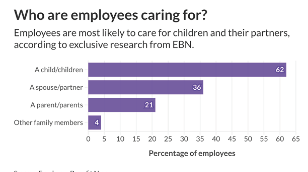
As it was in 2023, caring for children is still the most common form of caregiving, though it has risen from 42% to 62%. Care for adults has shifted, with those caring for a parent or parents down from 37% to 21% and those caring for a spouse rising from 29% to 36%, for example.
What hasn’t changed is the wide variety of conditions that require care. For respondents caring for children, neurodiversity, mental health challenges, vision and hearing impairment and fine motor skills are the most common conditions requiring help. Those caring for spouses or parents reported the most common assistance needs to be with physical mobility, memory issues, chronic illness and mental health challenges.
The responsibilities that come along with this are vast, as well. From transportation to meal planning to navigating healthcare, caregivers say that providing help requires much time, effort and mental capacity. The majority of those who care for children, parents or partners say they worry about care and support often or all the time.
While direct care, especially for children, is where people spend the majority of hours per week, coordinating their loved one’s care and other various support takes multiple hours, too. There is a hefty financial commitment for most caregivers as well; children again take the top spot, but those caring for adults often spend an average of hundreds per month.
It’s important to keep in mind that though women make up the majority of caregivers, more men are taking on this role, especially for their spouses. This means no matter the demographics of a workforce, there are bound to be caregivers who could benefit from employer support.
The Toll Caregiving Can Take
No matter what kind of care someone is providing, the experience can wear them down physically, emotionally and financially. Finding out where employees are seeing the most strain can help benefit leaders tailor offerings that make the most difference. For example, 43% of respondents reported feeling stressed or anxious, 35% were experiencing financial difficulty and one in five had delayed their own healthcare due to their obligations. Despite the challenges, the majority of respondents said they like or love many of the things that occupy their time as a caregiver, emphasizing the devotion they feel to their role. The more benefit leaders know about the kinds of care being done and its impact on their employees, the more they can do to help people balance this alongside their work.
benefitnews.com

Click To download the Key HR Newsletter UNCLOCKED

_________________________________
This communication is for informational purposes only; it is not legal, tax or
accounting advice; and is not an offer to sell, buy or procure insurance.
This post may contain hyperlinks to websites operated by parties other than KeyHR. Such hyperlinks
are provided for reference only. KeyHR does not control such websites and is not responsible for their content.
Inclusion of such hyperlinks on KeyHRO.com does not necessarily imply any endorsement of the material
on such websites or association with their operators
- Posted by admin
- On December 17, 2025
- 0 Comment

